AI tools have changed what a junior designer or developer does on day one. Here is what I now
weigh less on a CV, what I weigh more, how I test for it, and what candidates and employers in
Malta can do about it.
What has changed?
Over the past two years, AI tools have taken on much of the first-draft work that used to fill a
junior’s early weeks at our agency. Resizing assets, producing layout variations, writing
boilerplate code and drafting documentation now take minutes rather than days.
The work has not got smaller. It has moved. Juniors now spend more of their time reviewing,
choosing, refining and explaining, and they reach client conversations sooner. That is a harder
job, not an easier one. My rule of thumb is simple: AI for speed, people for judgement and
experience.
This matters more in a small market. The European Commission’s 2026 Digital Decade country
report for Malta puts the share of ICT specialists in employment at 4.8% in 2025, against 5.0%
for the EU. It also states: “The scarcity of specialised talent forces high-growth sectors like
Fintech, Gaming and Interactive Entertainment to rely on foreign labour.” When the pool is this
tight, every hire counts, and it pays to be clear about what you are really hiring for.
What matters less on a CV, and what matters more
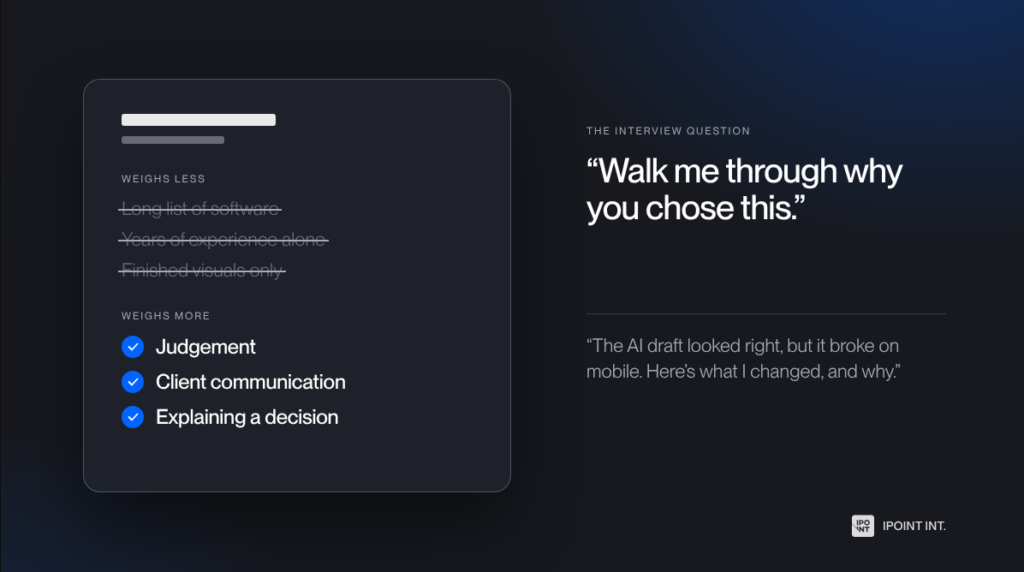
Some things I used to weigh heavily now tell me less. A long list of software is one. Tools change
every year, and capable people pick up a new one quickly. Years of experience on their own are
another: I would rather know what someone did with them. A portfolio of finished visuals still
matters, but on its own it does not show me the thinking behind it.
What I look for more is harder to fake:
- Judgement. Knowing which of five options fits this brief, this audience and this deadline,
and why. - Client communication. Listening properly, asking the question nobody else asked, and
explaining a trade-off without jargon. - The ability to explain a decision. If you can tell me why you chose this layout, this structure
or this approach to the code, I can trust you in front of a client. - Honesty about tools. Knowing where AI helped, where it was wrong, and what you
changed.
How I test for it
I keep it practical. First, I ask candidates to walk me through one piece of their own work, from
brief to delivery. Not necessarily the best-looking piece, but the one they learned most from. I
want to hear what they tried first, what they dropped and why.
Second, I ask how they used an AI tool on a real project and where they overrode it. Strong
answers are specific: a suggestion that looked right but failed on mobile, or generated copy that
missed the client’s tone. Vague answers, whether “I use it for everything” or “I never touch it”,
tell me much less.
Third, for some roles, a short practical task: time-boxed and, where possible, paid. I care less
about the output than about the questions asked before starting and how the result is
presented.
What candidates in Malta can do
- Show process, not only results. Two or three case studies with the brief, constraints,
options and final decision say more than twenty thumbnails. - Prepare one decision you can explain in depth, and practise saying it out loud.
- Be open about AI. Say where you used it, where you corrected it and why.
- Practise presenting to non-specialists. If a friend outside design or tech can follow your
reasoning, a client probably can too. - Learn the local context. A lot of digital work in Malta serves regulated sectors, including the
gaming and fintech sectors the Commission’s report mentions, where compliance, brand
rules and responsible messaging shape the work. Showing you understand those constraints
helps you stand out.
A note for employers
The bottleneck is rarely the tool. Eurostat reports that in 2025, among EU enterprises that had
ever considered using AI, the most common reason for not using it was “the lack of relevant
expertise (70.89%)”. People who can use these tools with good judgement are the scarce part.
A few practical steps follow. Write job adverts around the judgement and communication the
role needs, not a list of software. Keep assessment tasks short and respectful of candidates’
time. Give juniors early, supervised exposure to clients, because that is where judgement grows.
And invest in training: in a small talent pool, developing people is often more realistic than
finding them ready-made.
Antoine Vella is the founder of IPOINT INT., a Malta digital agency founded in 2010 that works
on branding, websites and digital products for iGaming, fintech and other businesses. He has
hired and worked alongside designers and developers in Malta since founding the agency.